
Checking Criminal History in Johnstown
Start by deciding which Johnstown record can answer the question. A police narrative belongs to Johnstown Police. A complaint, bail ruling, or preliminary hearing belongs to the proper Magisterial District Court. A felony or misdemeanor held for court appears later in Cambria County Common Pleas. Current custody is a separate Cambria County Prison matter, and a statewide repository response comes from Pennsylvania State Police through PATCH.
Use exact identifiers when possible. The police incident number points to the city file. The Offense Tracking Number, or OTN, follows an arrest through reporting systems. A docket number identifies one court case. They are not interchangeable.
- Ask Johnstown Police Records for the incident or crash report.
- Identify the ward and search the correct MDJ docket through UJS.
- Check Cambria County Prison or PA SAVIN if custody is the issue.
- Follow held charges to a CP-11-CR Common Pleas docket.
- Use PATCH or a subject-only PSP review for statewide repository history.
Johnstown Records at Washington Street
Johnstown Police Department operates around the clock at 401 Washington Street, Johnstown, PA 15901. Its main number is 814-539-0889, and Records is extension 311. The department's central system logs calls, complaints, criminal and noncriminal reports, arrests, crashes, juvenile paperwork, criminal complaints, and qualifying traffic stops. That breadth makes the city file valuable, but access rules can require redaction of victim, juvenile, private, or active investigative material.
The official Johnstown Police page is the source for current forms and contacts. The view below shows that official city channel.
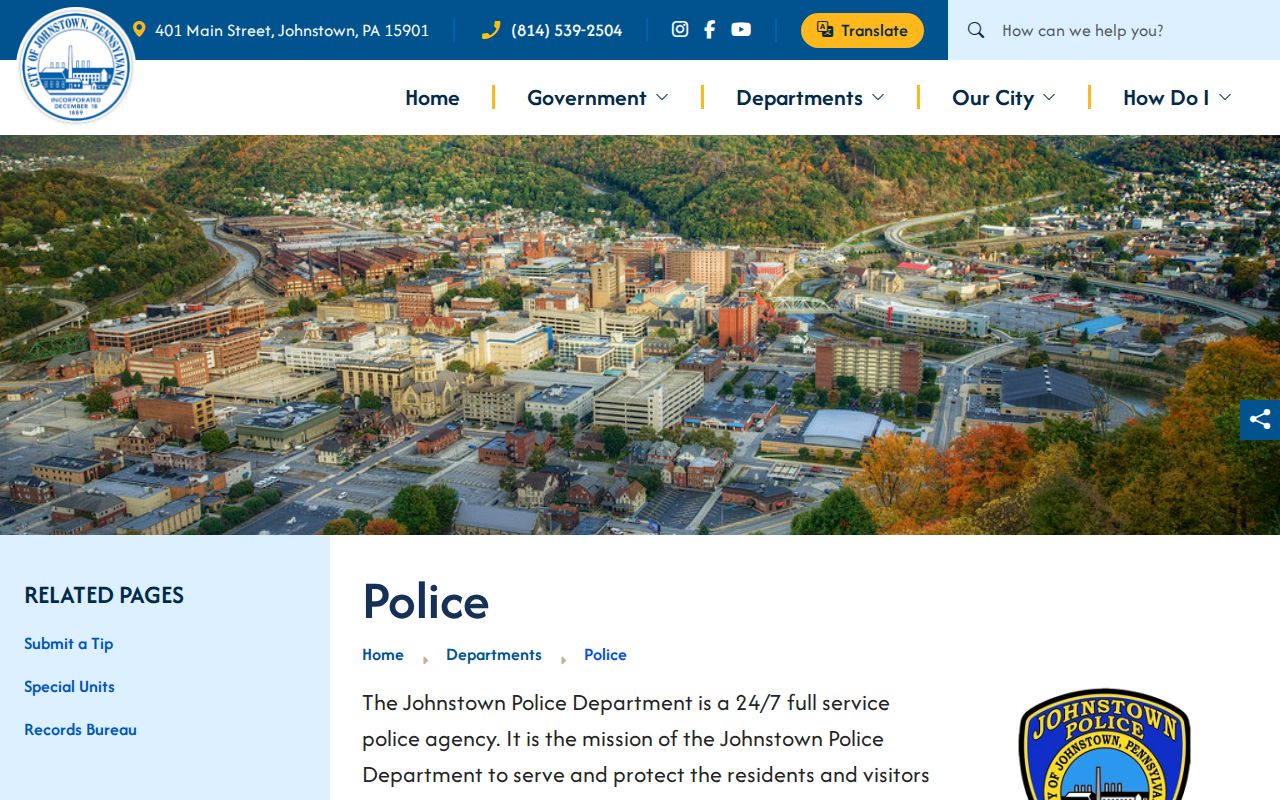
Use the current version posted there because Johnstown has updated its citizen complaint and report request forms.
Johnstown Police Department Records
A requester supplies a name, address, telephone or email, report type, incident date, location, and a detailed reason. The form also asks whether the requester is named in the report, represents an insurer, or acts for an agency. An incident number helps. Johnstown asks for a signature, identifying information, photo ID, payment, and a self-addressed stamped envelope when the record is returned by mail.
Only one report goes on each form. The researched fee is $15 for an accident report and 25 cents per page for an incident report. The form and FAQ have conflicting payment directions, so call Records before sending money. A full report may need redaction, and the department notes that a subpoena or court order can be required for material that cannot be released through the routine form.
Which Johnstown Court Has It?
Johnstown is split between MDJ 47-1-01 and MDJ 47-1-03. District 47-1-01, at the Central Park Complex, 110 Franklin Street, serves central and western wards and can be reached at 814-539-9982. District 47-1-03 is in Suite 202 of the same complex and serves southern and eastern wards; its number is 814-539-7791. Neighborhood names such as Center Town, Cambria City, Moxham, Morrellville, Roxbury, and Woodvale matter because the wrong district may not hold the paper file.
Search both cautiously when the exact incident location is unclear. Confirm the person with an OTN, incident number, birth information available in the public view, filing date, and arresting agency. A name match alone can join the wrong person to the wrong Johnstown case.
Johnstown Arrests and Bookings
Johnstown does not operate the county booking system. After an arrest, an officer creates the city report and complaint, while booked people generally enter Cambria County Prison at 425 Manor Drive in Ebensburg. No official public Cambria jail roster was found. For a recent custody question, call the Prison at 814-472-7330, check PA SAVIN or VINELink for participating custody, then search the UJS MDJ docket after the complaint is filed.
Timing matters. A recent event may not appear at once on UJS. PA DOC's locator is for state-sentenced inmates and parolees, not people held in Cambria County Prison. The broader Cambria County arrest lookup explains the full county fallback chain.
Johnstown Report or UJS Docket?
The Johnstown report and UJS docket answer different questions. The report can describe the call, location, officer response, probable cause, witnesses, and evidence, subject to lawful withholding. The docket shows the court caption, complaint, charges, bail, counsel, events, dispositions, sentence, and costs. It usually does not supply the whole police narrative.
A dismissed charge on UJS does not erase the earlier report or booking by itself. Likewise, an arrest charge may be changed when the District Attorney files the criminal information. Compare each charge line and read its disposition instead of assuming the first charge remained the final one.
Municipal Court Records in Johnstown
Pennsylvania has Magisterial District Courts, not a separate Johnstown municipal criminal court. The two Johnstown MDJs handle preliminary arraignments and hearings, traffic matters, nontraffic matters, and summary cases. Felony and misdemeanor charges held or waived move to the Court of Common Pleas in Ebensburg.
| Court Name | MDJ 47-1-01 or 47-1-03, based on ward and incident location |
|---|---|
| Case Types Heard | Criminal complaints, preliminary stages, traffic, nontraffic, and summary matters |
| Case Lookup Channel | Free UJS Public Web Docket Sheets, PAeDocket, or the district office |
| What the Docket Shows | OTN, charges, bail, events, counsel, and charge-level disposition |
| Copies & Fees | Ask the correct MDJ office; no local paper-copy fee was verified |
Search Johnstown Cases on UJS
On the UJS Public Web Docket Sheets, choose Magisterial District Courts for the first stage or Court of Common Pleas for a filed county prosecution. Select Cambria County, code 11. Search by participant name, docket, OTN, or police incident or complaint number. A date range helps with common names. Open the PDF and verify the agency, filing date, and charge details.
UJS warns that new office entries can lag and limited-access cases do not appear publicly, so absence from results is not proof that no protected record exists.
Where Johnstown Records Go
A Johnstown case can acquire several linked numbers as it moves. Police create the incident number and transmit reportable fingerprints and arrest data. The MDJ complaint receives an OTN and district docket. If charges are held for court, the District Attorney files an information and the Clerk maintains a CP-11-CR docket. Courts and justice agencies then report qualifying dispositions to the PSP Central Repository.
Record flow: Johnstown Police › Cambria County Courts › Pennsylvania State Police Central Repository
For a new event, start close to its source. For the legal outcome, read the later docket. PATCH provides a repository response, not the city narrative or every filing attached to the case.
Johnstown City Hall and Records
Johnstown's official municipal site helps distinguish police forms from other city business. The City of Johnstown is the source for current departmental routing and public notices.
City administrative records and criminal investigative records do not follow one identical access path. Send the report request to Police Records, not a general city counter, and use the correct court for the judicial file.
From Johnstown OTN to CP-11-CR
The OTN is often the best bridge between the police, MDJ, Common Pleas, and repository stages. A Cambria Common Pleas criminal docket resembles CP-11-CR-000####-YYYY. Here, 11 identifies Cambria and CR marks the criminal docket. The originating MDJ number remains useful when looking back to the complaint and preliminary events.
Read the docket charge by charge. “Held for court” means the prosecution met the preliminary standard; it is not a conviction. Later entries may show withdrawal, dismissal, nolle prosequi, plea, acquittal, conviction, sentence, or an appeal. A final outcome may differ sharply from the booked accusation.
Johnstown Redactions and Report Limits
Police reports can be partly public without being open in full. Johnstown may protect a victim identity, juvenile material, personal identifiers, medical facts, confidential sources, or details that would harm an active investigation. Ask for the portion that can be separated from exempt text. A cover page may confirm basic event data even when the narrative cannot be released.
A subpoena is not the routine starting point. Use the report form and let Records identify the access issue first. If a court order is required, the requester then has a specific description of what was withheld. Keep the police response separate from a UJS correction request. Johnstown Police controls its own report, while court staff control docket entries.
Johnstown Custody Alerts After Arrest
PA SAVIN and VINELink offer a second route after a Johnstown arrest when the goal is custody status or a release alert. Search by first and last name, verify the participating facility, and choose phone, text, email, or app notice where offered. This service is a notification layer. It does not supply the Johnstown Police narrative, decide guilt, or replace the MDJ docket.
Use the alert with the Prison phone and UJS. The Prison confirms present county custody, while UJS shows whether a complaint and bail order have reached the court system. A release alert can reflect transfer, bail, sentence completion, or another authorized event. Read the docket before drawing a conclusion about why custody changed.
Keep the control numbers from each system. A SAVIN registration number, police incident number, OTN, and docket number each help a different custodian find the right item. Record the date of every call as well. That small log is useful when a new Johnstown complaint has not yet reached UJS or a custody status changes before the next court entry posts.
Public Access Rules in Johnstown
The record's custodian controls the request. Johnstown Police applies Pennsylvania access law to its reports. MDJs and the Clerk follow Pennsylvania Supreme Court case-record policy, not the ordinary county RTKL route. PSP controls repository records. Investigative details, juvenile files, victim data, personal identifiers, and limited-access matters may be withheld or redacted.
Key Statutes:
Pennsylvania Right-to-Know Law sets the general agency-request process but does not replace judicial access rules.
18 Pa.C.S. § 9121 governs public dissemination of Pennsylvania criminal-history information.
Supreme Court Case Records Policy protects confidential data while defining access to court records.
Ask for segregable public portions when a report contains exempt material. If the issue is a court record, use the UJS request or correction process rather than a general open-records appeal.